Description
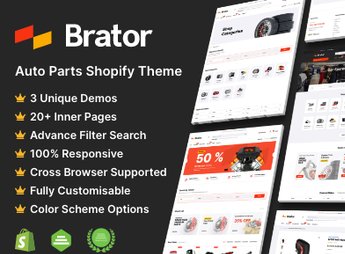
Brator sets up an auto parts and repair shop Shopify store, with a product grid organized by category, filtering by vehicle make and model, a product page with technical specifications and a banner section for store promotions. Anyone selling parts, accessories, or vehicle maintenance services online gets a storefront built for technical catalogs, with room for detailed photos and model compatibility.
Brator’s Main Features
- Filter by make and model
Lets customers find compatible parts by filtering by their vehicle directly in the store. - Grid by category
Organizes the catalog into sections like engine, suspension, brakes and accessories. - Product spec sheet
Displays specifications, compatibility and detailed images for each part sold. - Promotions banner
Sets aside space on the homepage to highlight deals and new part releases. - Technical catalog layout
Organizes text and images legibly for long part specifications.
Brator’s Benefits
- More accurate search
Reduces wrong-part purchases by making compatibility visible before checkout. - Organized catalog
Makes navigation easier in stores with many technical items and varied categories. - Less doubt when buying
Complete spec sheets cut down on repeated questions about part compatibility. - A store that looks like a specialist
The technical layout builds more trust with shoppers looking for specific parts.
Who Is Brator Recommended For?
- Anyone selling new or used auto parts online.
- Anyone running an auto repair shop who wants to sell individual parts online.
- Anyone reselling auto accessories and repair items.
- Anyone serving parts distributors who needs an organized technical catalog.
How to Download Brator
Brator is available for download here on Ultrapack. After downloading the file, go to your Shopify dashboard and navigate to Online Store > Themes > Add theme to upload the package and activate it on your store. Then adjust categories, banners and text to match your auto parts catalog.
Auto parts catalogs tend to have a large volume of similar items, and the difference between making the sale and losing the customer to a competitor comes down to how fast they find the right part. A structure built for this kind of search reduces cart abandonment and rework in customer support.
Frequently asked questions
Is Brator – Auto Parts Shopify Theme GPL?
Yes. Brator – Auto Parts Shopify Theme is distributed under the GPL (GNU General Public License). You may legally use, modify and redistribute it on as many sites as you want.
Can I use Brator – Auto Parts Shopify Theme on more than one site?
Yes. You can use Brator – Auto Parts Shopify Theme on as many sites as you want.
How much does Brator – Auto Parts Shopify Theme cost at Ultrapack?
Brator – Auto Parts Shopify Theme costs US$2.99 as a single purchase, and it is also included in the subscription plans starting at US$17/mo (Desenvolvedor I).
Does Brator – Auto Parts Shopify Theme include updates?
When a new version of Brator – Auto Parts Shopify Theme becomes available in the catalog, you can download the file during the access period of your purchase or subscription. To update, follow the installation or import procedure described in the documentation for the item and its platform.
Is Brator – Auto Parts Shopify Theme checked before it is made available for download?
Files for Brator – Auto Parts Shopify Theme are scanned before publication by UltraHub using ClamAV and YARA rules to detect known threats. This check does not guarantee the absence of risks. Check the item requirements, make a backup, and follow the installation or import instructions for its platform.
How to install
Updates: manual. When a new version comes out, download it on this same page and upload the new file from the Shopify admin. This item is not installed through WordPress.
A Shopify theme is not installed on WordPress. It is uploaded in your store dashboard.
- Download the file
elements-brator-auto-parts-shopify-theme.zipand extract it on your computer. - Inside the package, look for the theme ZIP, which is the file Shopify accepts. It is usually in a folder named after the theme, and it has the
assets,layout,sectionsandtemplatesfolders inside. - In the Shopify dashboard, go to Online Store > Themes.
- Under Theme library, click Add theme > Upload zip file and upload the theme ZIP.
- Use Preview to check it, and Publish when you want it live.
- Shopify rejects packages that are too large. If the upload fails because of size, take the documentation and demo files out of the folder before zipping it.
Stuck on a step? Open a ticket telling us which one you stopped at.