Description
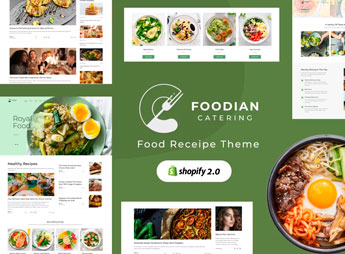
Foodian builds a Shopify store aimed at people selling food, recipes, organic products and bakery or restaurant items, with showcase blocks that combine dish photos, ingredient lists and product categories on a single page. The theme organizes recipe and product side by side on the same page, which helps whoever publishes kitchen content alongside sales keep the visitor browsing between the blog and the cart without switching layouts.
Main Features of Foodian
- Showcase for food products
Displays photos of dishes and ingredients in blocks organized by product category. - Integrated recipe section
Publishes step-by-step recipes on the same page where the product is sold. - Responsive catalog layout
Automatically adjusts product grids and images for mobile and tablet. - Filters by food category
Lets the customer filter by type of food, diet or occasion of consumption. - Featured sections on the homepage
Sets up banners and featured product blocks right on the homepage.
Benefits of Foodian
- Store with a blog feel
Combines recipe content and product sales without needing two separate sites. - Faster navigation
Reduces the number of clicks until the customer finds the right product. - Ready-made visual identity
Comes with a color palette and typography already adjusted for the food niche. - Less setup time
Comes with sections and blocks already built, reducing the initial assembly work.
Who Is Foodian Recommended For?
- Anyone selling meal boxes, organic products or bakery items online.
- Anyone who publishes recipes and wants to sell the ingredients used in them.
- Anyone who runs a restaurant or delivery service with online ordering.
- Anyone who puts together baskets or kits of food products as gifts.
How to Download Foodian
Foodian is available for download here on Ultrapack. After downloading the file, go into the store’s dashboard and follow Online Store > Themes > Add theme to upload the package and publish the layout to your Shopify account.
Before publishing, it’s worth reviewing the color and font options in the theme editor to adapt the look to your brand’s or menu’s identity. The theme follows Shopify’s standard structure, so any change to text, image or section can be made without touching code, directly through the platform’s visual editor.
Frequently asked questions
Is Foodian – Food Blog Shopify Store GPL?
Yes. Foodian – Food Blog Shopify Store is distributed under the GPL (GNU General Public License). You may legally use, modify and redistribute it on as many sites as you want.
Can I use Foodian – Food Blog Shopify Store on more than one site?
Yes. You can use Foodian – Food Blog Shopify Store on as many sites as you want.
How much does Foodian – Food Blog Shopify Store cost at Ultrapack?
Foodian – Food Blog Shopify Store costs US$2.99 as a single purchase, and it is also included in the subscription plans starting at US$17/mo (Desenvolvedor I).
Does Foodian – Food Blog Shopify Store include updates?
When a new version of Foodian – Food Blog Shopify Store becomes available in the catalog, you can download the file during the access period of your purchase or subscription. To update, follow the installation or import procedure described in the documentation for the item and its platform.
Is Foodian – Food Blog Shopify Store checked before it is made available for download?
Files for Foodian – Food Blog Shopify Store are scanned before publication by UltraHub using ClamAV and YARA rules to detect known threats. This check does not guarantee the absence of risks. Check the item requirements, make a backup, and follow the installation or import instructions for its platform.
How to install
Updates: manual. When a new version comes out, download it on this same page and upload the new file from the Shopify admin. This item is not installed through WordPress.
A Shopify theme is not installed on WordPress. It is uploaded in your store dashboard.
- Download the file
elements-foodian-food-blog-shopify-store.zipand extract it on your computer. - Inside the package, look for the theme ZIP, which is the file Shopify accepts. It is usually in a folder named after the theme, and it has the
assets,layout,sectionsandtemplatesfolders inside. - In the Shopify dashboard, go to Online Store > Themes.
- Under Theme library, click Add theme > Upload zip file and upload the theme ZIP.
- Use Preview to check it, and Publish when you want it live.
- Shopify rejects packages that are too large. If the upload fails because of size, take the documentation and demo files out of the folder before zipping it.
Stuck on a step? Open a ticket telling us which one you stopped at.